Your Stylesheet Already Speaks Fluent 3D — You Just Haven't Noticed
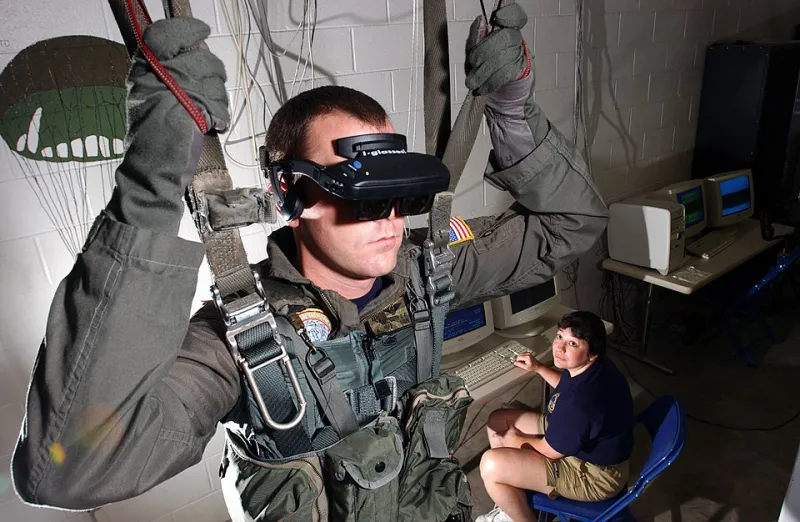
Photo: Svenar, CC BY-SA 4.0, via Wikimedia Commons
There's a moment that happens in almost every conversation I have with web developers who are nervous about spatial work. They tell me 3D is a different world. It's graphics programming. It's WebGL shaders and quaternion math and a whole new mental model they'll need years to build.
Then I open their codebase, scroll to a card component, and point at transform: perspective(800px) rotateX(12deg).
They've been doing 3D the whole time. They just haven't been counting it.
The Flat Web Was Never Actually Flat
The history here is worth revisiting, because it explains why spatial web work feels less like a career change and more like a promotion.
CSS gained 3D transforms back in 2009, and browsers shipped them steadily through the early 2010s. Suddenly a stylesheet could describe a plane in space, rotate it around an axis, and define a vanishing point with a single perspective property. The web didn't make a big announcement about this. Designers used it for flashy card flips, everyone got a little tired of card flips, and the deeper implications got filed under "cool demo tech."
But look at what actually entered the language:
perspective— a real camera model, with a focal length you controltransform-style: preserve-3d— a scene graph, where children inherit their parent's coordinate spacetranslateZ,rotateY,rotateX— movement along and around axes that have nothing to do with the document flowbackface-visibility— culling, the same trick game engines use to skip drawing surfaces you can't see
That's not decoration. That's the vocabulary of spatial computing wearing a CSS trench coat.
Stacking Contexts: The Depth Model You Already Debug
Here's the concept that convinces skeptics: z-index.
Every developer who has ever wrestled with a dropdown appearing under a modal has been managing a depth buffer. Stacking contexts are, functionally, a painter's algorithm — the same approach early 3D renderers used to decide what draws on top of what. When you create a stacking context with transform or opacity, you're carving the page into depth layers, exactly the way a compositor does when it decides which pixels win.
The infamous "why is my z-index not working" bug? That's a lesson in how depth hierarchies nest. A child's position in 3D space is relative to its parent's context — which is precisely the mental model you need for preserve-3d scenes, where a rotated container drags all its descendants into the same perspective.
If you can debug a stacking context, you can reason about a 3D scene. You've just been doing it in a coordinate system with one fewer axis.
From Layout to Landscape
So what does the actual leap look like? Smaller than the marketing suggests.
Step one is reframing. Instead of thinking of the viewport as a page, think of it as a window. Your perspective value is the distance from the viewer to that window. Crank it high and everything looks flat and safe. Pull it low and you get dramatic depth — and motion sickness if you overdo it. Every spatial interface you'll ever build lives somewhere on that dial.
Step two is composition. transform-style: preserve-3d is your scene graph. A dashboard where panels sit at slightly different depths, tilting subtly toward the user as the pointer moves — that's not a WebGL project. That's a stylesheet. I've seen product teams ship genuinely spatial-feeling interfaces with zero JavaScript rendering libraries, just transforms driven by pointer position and a well-chosen perspective origin.
Step three is performance intuition. If you've ever been told to animate transform and opacity instead of top and left because they're GPU-composited — congratulations, you've been optimizing a 3D renderer. The browser promotes transformed layers to the compositor thread, which is the same reason your Three.js scene should avoid re-layouts. The instincts transfer one-to-one.
Where CSS Hands Off to the GPU
None of this means WebXR and WebGL are unnecessary. There's a ceiling. CSS gives you flat surfaces arranged in space, not geometry, lighting, or true interactivity inside a 3D volume. When you need meshes, shaders, or head-tracked rendering, you graduate to the heavier tools.
But here's the thing about that graduation: the concepts carry over. A transform hierarchy in Three.js is your transform hierarchy in CSS with more knobs. A camera with a field of view is your perspective property with math attached. Even the pain transfers — nested coordinate spaces will betray you in any rendering system ever built.
The industry has a habit of treating spatial computing as a hard reset, a generation of tooling that renders existing skills obsolete. The stylesheet tells a different story. The web spent fifteen years quietly teaching every front-end developer the fundamentals of depth, parallax, and layered rendering, one vendor-prefixed property at a time.
You're not starting from zero. You're starting from perspective: 1000px — and honestly, that's further along than most people realize.